

 العربية
 اردو
اردو 中文
中文PINT OM explained in plain language
· 6 min
The specification your invoices are validated against. What a country specialisation is, why it exists, and which parts of it your finance team actually owns.
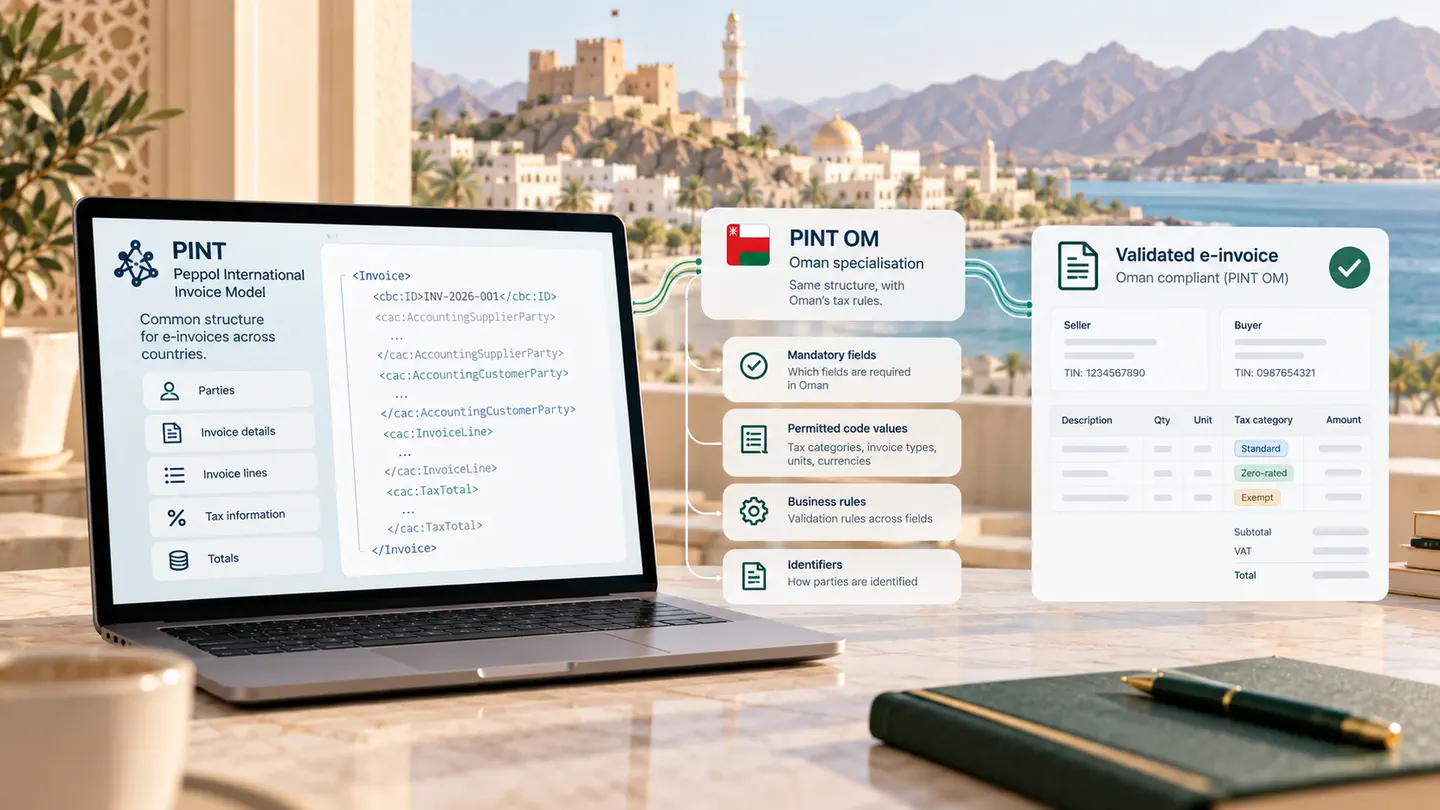
Somewhere in every Fawtara conversation, someone says PINT OM, and the room divides into people who nod and people who write it down to look up later.
It is simpler than it sounds.
What it is
PINT is the Peppol International invoice model: a common structure for an electronic invoice, designed to work across countries. It defines what an invoice is made of — the parties, the lines, the tax breakdown, the totals — in a way that software anywhere can read.
A country specialisation narrows that general model to one country's tax law. PINT OM is the Oman specialisation: the same structure, with Oman's own rules about which fields are mandatory, which code values are permitted, and what has to be true for an invoice to be valid here.
Why a specialisation exists at all
Because tax is local and software is not. A general model that tried to satisfy every country's rules would be unusable; one that ignored them would be useless. The specialisation is the join between the two.
Practically, it means a vendor who has implemented Peppol invoicing elsewhere is most of the way there — and the remaining distance is exactly the part that matters for compliance in Oman.
What it constrains
- Which fields are mandatory. Fields that are optional in the international model may be required here.
- Which code values are allowed. Tax categories, invoice type codes, unit codes and currencies come from fixed lists, not free text.
- Business rules across fields. Rules that relate one value to another — that a tax amount is consistent with its base and rate, that a credit note references the invoice it corrects.
- Identifiers. How the parties to the invoice are identified, which is where most first-attempt failures come from.
A validation rule is not a formatting preference. An invoice that breaks one is not a slightly untidy invoice; it is not an invoice.
Which parts your finance team owns
Almost none of the technical specification, and almost all of the data that goes into it. Your service provider maps your data into PINT OM. They cannot supply what you never recorded.
- Customer tax identifiers. Complete, current and correctly formatted for every VAT-registered customer.
- Tax treatment per line. Standard, zero-rated and exempt distinguished at line level, not applied as a whole-invoice assumption.
- Units and quantities. Real units of measure, consistently used.
- References. Purchase order numbers, contract references and, for credit notes, the original invoice.
Related questions
Do we need to read the specification?
No. You need to know which of your data it depends on, which is the list above. Your provider reads the specification.
Does it change?
Specialisations are versioned and do change. That is a question for your provider: how they handle a version change, and whether it costs you anything.
Is it the same as the five corner model?
No, and the two get confused constantly. PINT OM is what is sent. The five corner model is how it travels.
For the data work this implies, see the fields that cause most rejections.