

 العربية
 اردو
اردو 中文
中文The Peppol network model for Omani finance teams
· 6 min
Five corners, two of them service providers. Here is the Oman Tax Authority's own model, and what each corner is responsible for.
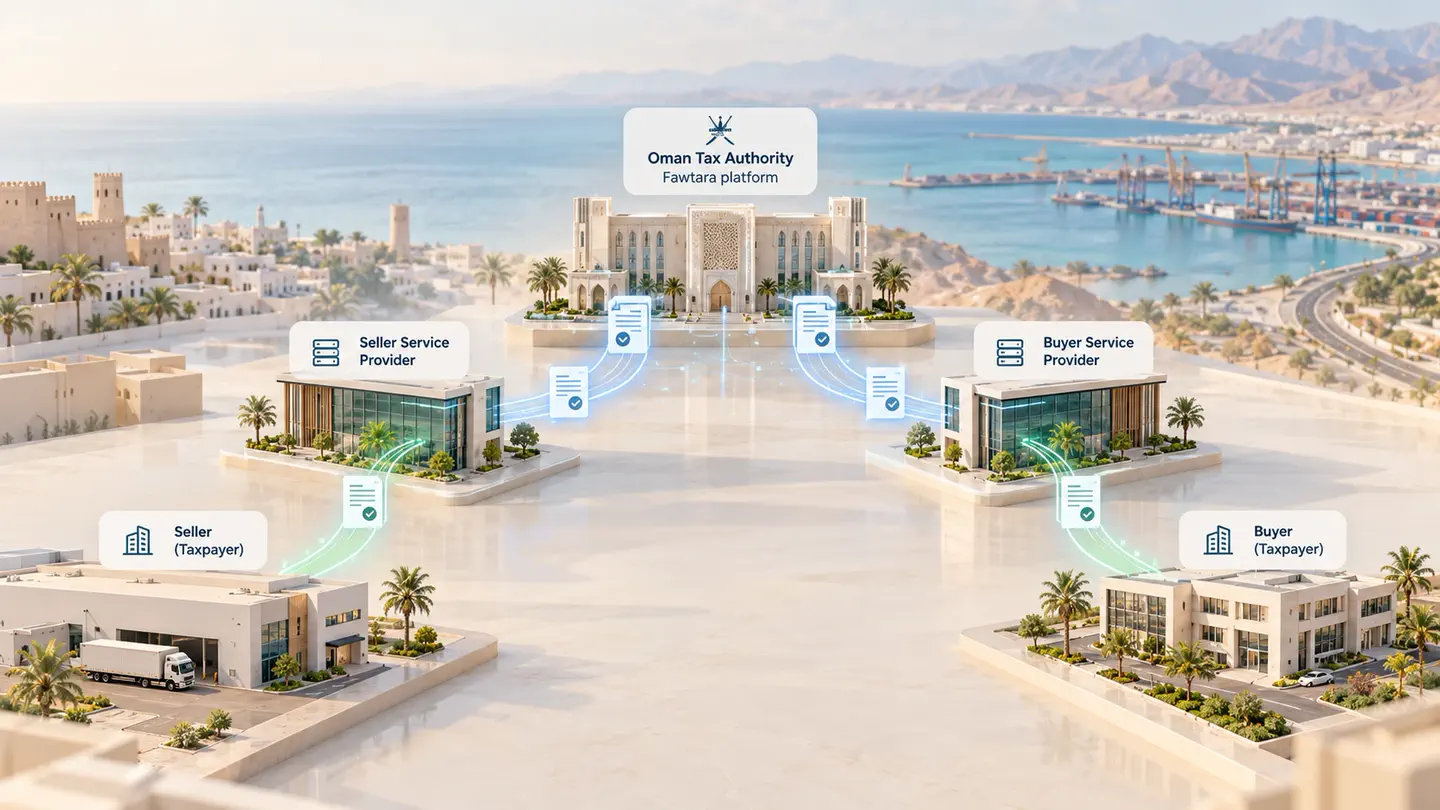
Fawtara does not work like filing a return. Nothing is uploaded to a government website one invoice at a time. It works like a postal network, and the Oman Tax Authority describes it as a five corner model.
Understanding the five corners is what makes every other decision in this programme straightforward, because each one tells you whose problem a given thing is.
The five corners
- Corner 1 — Seller (Taxpayer). The business issuing the e-invoice.
- Corner 2 — Seller Service Provider. The Accredited Service Provider that prepares, validates and sends the invoice on the seller's behalf.
- Corner 3 — Buyer Service Provider. The service provider that receives the validated invoice and delivers it to the buyer.
- Corner 4 — Buyer (Taxpayer). The business receiving and processing the e-invoice.
- Corner 5 — Oman Tax Authority (Fawtara platform). The central platform that validates, monitors and oversees e-invoice exchanges to ensure compliance with tax legislation.
What this means for you as a seller
You are corner one. Your responsibility is the content of the invoice: that the data is complete, correct and produced in time. You are not responsible for the transport, the format conversion or the connection to the network — those belong to corner two, which is the service provider you appoint.
This is why the quality of your master data matters more than the sophistication of your accounting software. A service provider can carry an invoice onto the network. It cannot invent a customer's tax identifier that was never recorded.
What this means when you are the buyer
You are also corner four, on every invoice your suppliers send you. Invoices will start arriving as data rather than as attachments, which changes accounts payable more than most finance teams expect: less keying, more matching, and far less tolerance for an invoice that does not reference a purchase order correctly.
Most businesses plan for corner one and are surprised by corner four. The receiving side arrives at the same time and nobody owns it.
Why there are two service providers and not one
Because you choose yours and your customer chooses theirs. Neither of you has to agree on software, and neither of you is locked to the other's choice. The two providers agree on the format between them; that agreement is what accreditation is for.
Related questions
Can one company be both corner two and corner three?
Yes. An Accredited Service Provider in Oman is accredited to act on both sides. If you and your customer happen to use the same ASP, the invoice still follows the same path.
Does the Oman Tax Authority see every invoice?
Corner five validates and monitors the exchange. That is a stronger position than receiving a monthly summary and a different one from standing in the middle of every delivery.
What happens if our service provider's accreditation lapses?
You would need to connect to another one. This is worth knowing before you sign, which is why the questions to ask a provider include their accreditation status and their exit terms.
Our integrations page covers how an accounting system reaches corner two, and the compliance guide places the model in the wider framework.