

 العربية
 اردو
اردو 中文
中文What counts as an e-invoice in Oman, and what doesn't
· 5 min
A PDF emailed to a customer is not an e-invoice. The difference is structural, and it is the thing most finance teams get wrong first.
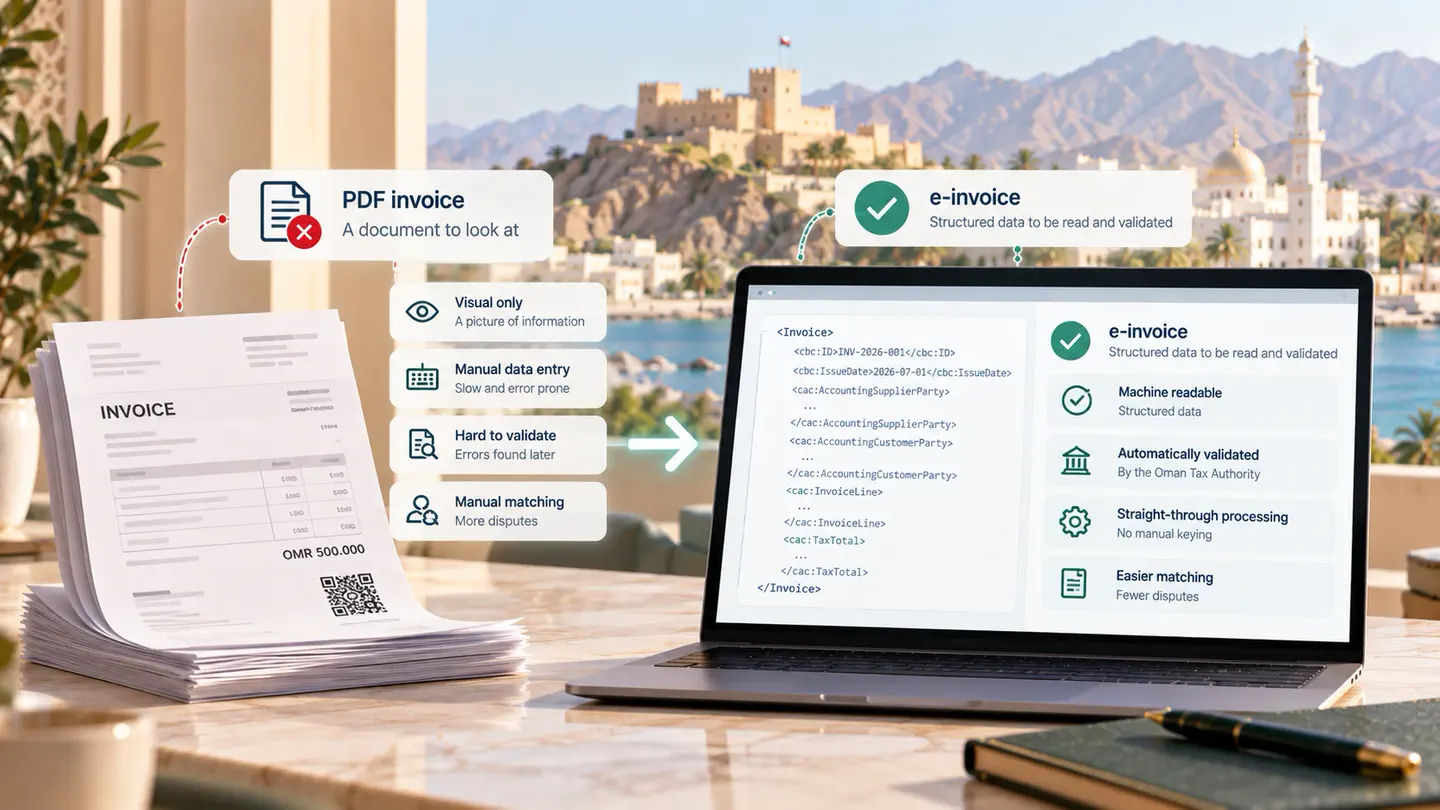
Ask a finance team in Oman whether they already issue electronic invoices and most will say yes. They email PDFs. Under Fawtara, that is not an e-invoice, and the gap between the two is the single most expensive misunderstanding in this programme.
The short answer
An e-invoice is structured data, exchanged machine to machine, in a format the Oman Tax Authority can read and validate automatically. A document that a person has to open and read is not one, whatever file type it arrives in.
What makes an invoice an e-invoice
- It is structured. Every value — the buyer's tax identifier, the tax category of each line, the invoice type — sits in a named field, not in a line of text that happens to contain it.
- It follows one agreed specification. Both the sender's system and the receiver's system interpret the same field the same way, because the specification says what it means.
- It is validated. It is checked against rules before it is accepted, and a failure is reported rather than discovered later.
- It is delivered over the network. It travels through accredited service providers rather than through an inbox.
What does not count
- A PDF attached to an email, even a digitally signed one.
- A scanned paper invoice, however high the resolution.
- An invoice image uploaded to a customer portal.
- A spreadsheet of invoice lines sent to a customer's accounts team.
- A printed invoice with a QR code added to it.
Each of those is a digital invoice. None of them is an electronic invoice in the sense the Oman Tax Authority means, because in every case the data has to be read back out of a document by a human or by guesswork.
The test is simple: if a person has to look at it for the numbers to be understood, it is a document, not an e-invoice.
Where the Oman Tax Authority fits in
Fawtara is built on a five corner model. The seller and the buyer are the outer corners; each is served by an Accredited Service Provider; and the Oman Tax Authority's Fawtara platform is the fifth corner, validating and monitoring the exchange rather than sitting in the middle of every delivery.
That fifth corner is why the structure matters. A platform cannot validate a picture of an invoice.
Related questions
Can we keep sending PDFs to customers as well?
Yes, and most businesses will. A human-readable copy remains useful for your customer's own records. It simply is not the thing that satisfies the obligation.
Does the customer need the same system as us?
No. That is the point of a network model: your service provider and theirs agree on the format, so your system and their system do not have to.
What happens to our invoice numbering?
It continues, and it becomes more important. Sequence, uniqueness and references to earlier invoices are fields that get validated rather than conventions that get tolerated.
The compliance guide works through the whole framework, and our platform page covers how invoice data gets from an accounting system into this shape.