

 العربية
 اردو
 中文
Before you replace your accounting software for Fawtara, read this
· 5 min
Preparing for e-invoicing in Oman? Start by assessing your existing system. These six questions can help you decide before investing in a replacement.
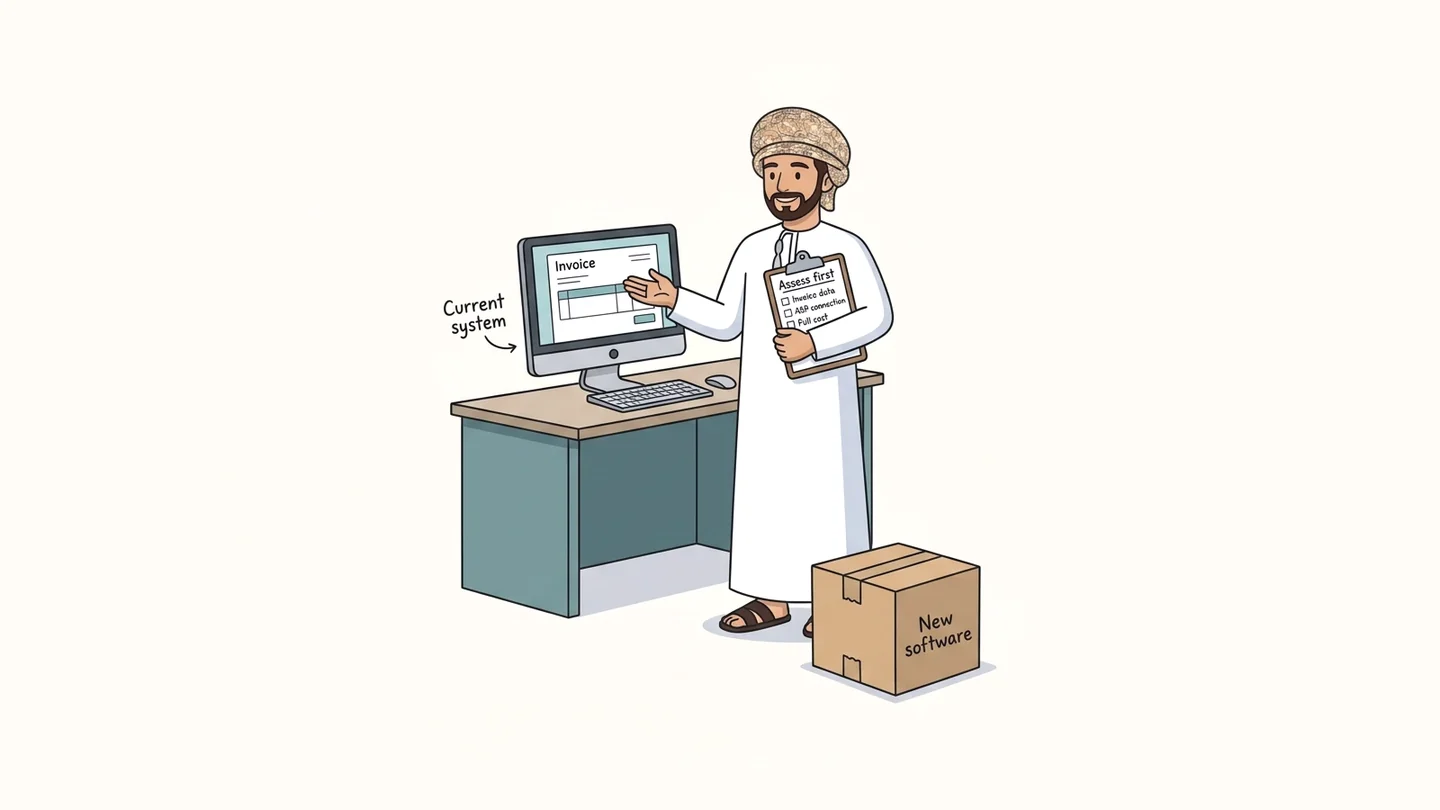
Replacing accounting software affects more than invoices. It can mean moving records, retraining staff and changing routines across the business.
Before taking that step for Fawtara, check whether your current system can be connected.
The Oman Tax Authority's published FAQ allows existing ERP systems to be retained depending on the arrangement with the accredited service provider, with data mapped against Oman's specifications. Keeping your software is therefore an option to assess, rather than a guarantee for every product.
Source: Oman Tax Authority Fawtara FAQ, section 3.4
1. Can your system provide the required invoice data?
A professional-looking invoice does not establish that its underlying data is ready for electronic exchange.
Ask your provider to review actual invoice samples and the information your system can export. Identify where customer details, tax information and invoice line items are stored, and what needs correcting or completing.
This gives you a practical starting point before discussing new software.
2. How will your system connect to Fawtara?
Ask for a clear explanation of the proposed connection:
- Does it support your software product and version?
- Is the connection available now, or does it require development?
- Which steps happen automatically?
- Will staff need to enter information more than once?
Fawtara's operating model connects sellers, buyers, service providers and the Tax Authority. Your implementation proposal should explain where your system fits and how its data will move through that process.
Source: Oman Tax Authority e-invoicing overview
3. Who checks invoices and handles errors?
Service providers validate invoice formats and rules, while responsibility for invoice compliance remains with the taxpayer.
Source: Oman Tax Authority service provider FAQ, questions 20 and 21
That makes error handling an essential part of your assessment.
Ask how your team will be notified when an invoice fails validation, how the problem will be explained and who will correct it. Agree on responsibilities before going live.
4. Where will records be stored, and can you retrieve them?
Ask how you will access original electronic invoices, search historical records and export them if you change providers.
Confirm the hosting location directly, too. The Tax Authority's provider directory states that data-residency information is supplied by providers and is not independently verified by the Authority. Ask for the location of your data to be clearly documented in your contract.
Source: Oman Tax Authority accredited service providers
5. What is the full cost of keeping your system?
Request an itemised proposal covering setup, custom development, recurring charges, invoice-volume charges, support and data export.
Compare it with the cost of replacement, including migration and staff training. Assess both options against the same business requirements before choosing.
6. Can you see your own workflow demonstrated?
A demonstration using your business's invoice examples is more useful than a generic product presentation.
Ask to see the process from invoice creation through validation, exchange and record retrieval. Include an example containing an error so you can see how it is identified and corrected.
Use the demonstration to establish what is ready, what requires configuration and what still needs development.
Start with an assessment
You may be able to retain your accounting system. You may need changes to its data or connection settings. In some cases, replacement may be appropriate.
The first step is to establish which option suits your business.
Book Dhara's free Fawtara readiness assessment to review your accounting system, invoice data and connection requirements before deciding what to change.